One of the things that distresses me in Montana is the sense you get, starting about July, that the whole damn place is about to go up in flames. Drought conditions have afflicted the American West for more than a decade, and it's spreading. Now up to a third of the entire U.S. is suffering from drought.
I've been spending time in Montana for seven or eight years now, and I have no recollection of summer conditions that weren't incredibly dry. It's remarkable if you're not used to it. It's as if you can feel the dryness sapping the moisture from your body. There's almost a friction to the air.
In these conditions, the slightest spark can destroy thousands of acres.
I'm eyeing the weather report tonight, because scattered thunderstorms are forecast for Thursday. It seems this is how so many fires are sparked in that area -- by thunderstorms that don't offer enough wetness to discourage fire, but just enough lightning to start one.
Fires are already burning all over the West, including Oregon, Washington and Montana.
I spent some time in Glacier in 2003 when the park was besieged by fire, and it made an stark impression on me. Last week I walked through some of the forest that had burned during that summer, and observed the succession -- beautiful wildflowers against black, charred tree trunks.
Time. As I strolled through the burn I marveled: it's only time that's the difference between a leisurely walk and standing in the middle of an inferno.

Dozing polar bear, Indianapolis Zoo
Showing posts with label Wildfires. Show all posts
Showing posts with label Wildfires. Show all posts
Monday, July 09, 2007


Wednesday, November 29, 2006
Stop me before I anthropomorphize again
The interesting thing about a house in the woods is that the trees are always trying to take over. Pine trees are the dandelions of the mountains. Of course, I've always taken a contrary position on weeds -- I infinitely prefer them to manicured lawns. And so I do as well with my coniferous friends. They are, after all, merely trying to reclaim the space we've taken from them.
But this creates a certain dilemma in a region where one's embrace of the term "defensible space" can be a matter of life or death, should you be unlucky enough to find yourself in the midst of a raging forest fire. In northwestern Montana, as in many other places here in the American west, how well you clear your property of "fuel" can sometimes determine whether your home is a complete loss or is only lightly charred.
I find it difficult not to cheer the little upstarts that take root in my corral and even in the patch of land in front where the lupines grow in spring. I feel the same way about the ones that have poked up in the protective shadow of the house. They're small, they're uppity and they're ambitious -- all qualities I cannot help but admire. But the fire people tell me I should "remove" them.
I'd hate to do it. I like them. Who wouldn't?
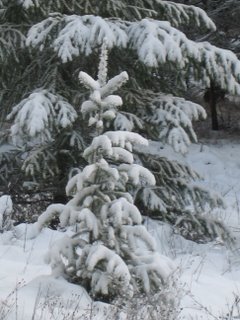
Blast it all, it rubs my fur the wrong way to yank out a tree. I'm simply not one of those people who can rearrange vegetation willy-nilly as though moving around the living room furniture. A neighbor once observed to me that she intended to remove a hundred-year old cottonwood in favor of "more manageable trees." My mouth yawped open, unable to speak.
More manageable trees? That seemed an unspeakably capricious reason to remove a tree, especially one as venerable as that cottonwood. To me, there ought to be a very good reason to remove a tree.
Like, perhaps, defensible space.
Right now, this is a question I need not face at the Ranch. There will be no lightning to spark a blaze for several months, and with the canopy of snow overlaying the winter forest, nothing would light anyway. But the dry summer months loom, inevitable, with hard choices their traveling companions.
But this creates a certain dilemma in a region where one's embrace of the term "defensible space" can be a matter of life or death, should you be unlucky enough to find yourself in the midst of a raging forest fire. In northwestern Montana, as in many other places here in the American west, how well you clear your property of "fuel" can sometimes determine whether your home is a complete loss or is only lightly charred.
I find it difficult not to cheer the little upstarts that take root in my corral and even in the patch of land in front where the lupines grow in spring. I feel the same way about the ones that have poked up in the protective shadow of the house. They're small, they're uppity and they're ambitious -- all qualities I cannot help but admire. But the fire people tell me I should "remove" them.
I'd hate to do it. I like them. Who wouldn't?
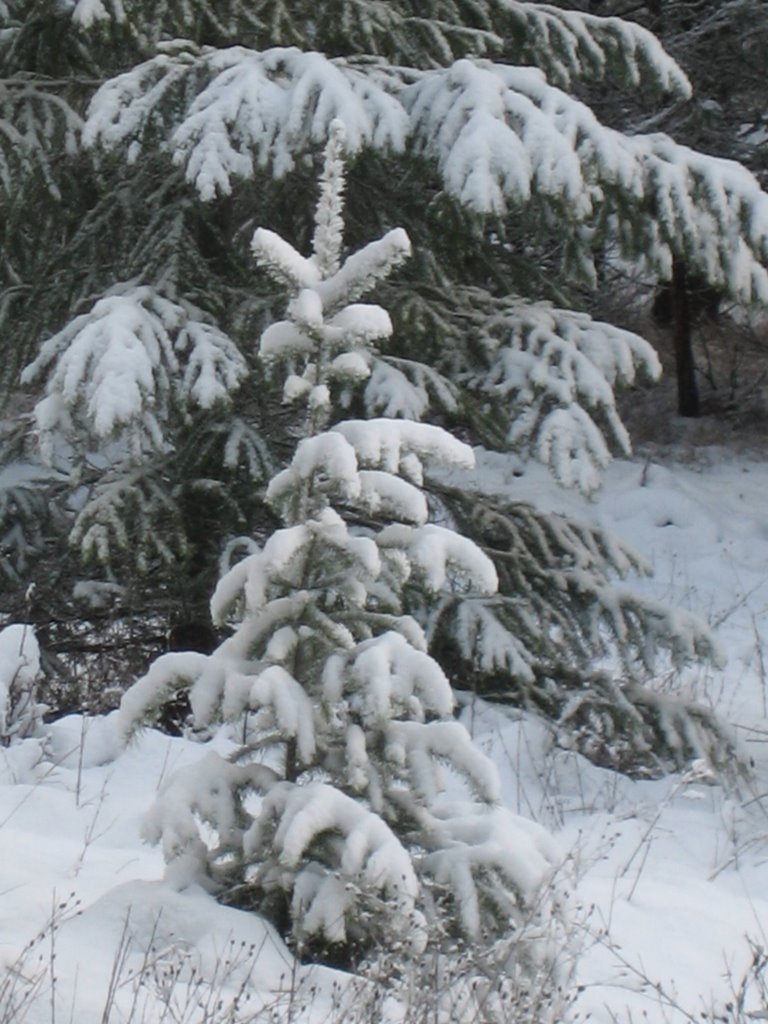
Blast it all, it rubs my fur the wrong way to yank out a tree. I'm simply not one of those people who can rearrange vegetation willy-nilly as though moving around the living room furniture. A neighbor once observed to me that she intended to remove a hundred-year old cottonwood in favor of "more manageable trees." My mouth yawped open, unable to speak.
More manageable trees? That seemed an unspeakably capricious reason to remove a tree, especially one as venerable as that cottonwood. To me, there ought to be a very good reason to remove a tree.
Like, perhaps, defensible space.
Right now, this is a question I need not face at the Ranch. There will be no lightning to spark a blaze for several months, and with the canopy of snow overlaying the winter forest, nothing would light anyway. But the dry summer months loom, inevitable, with hard choices their traveling companions.
Subscribe to:
Posts (Atom)


